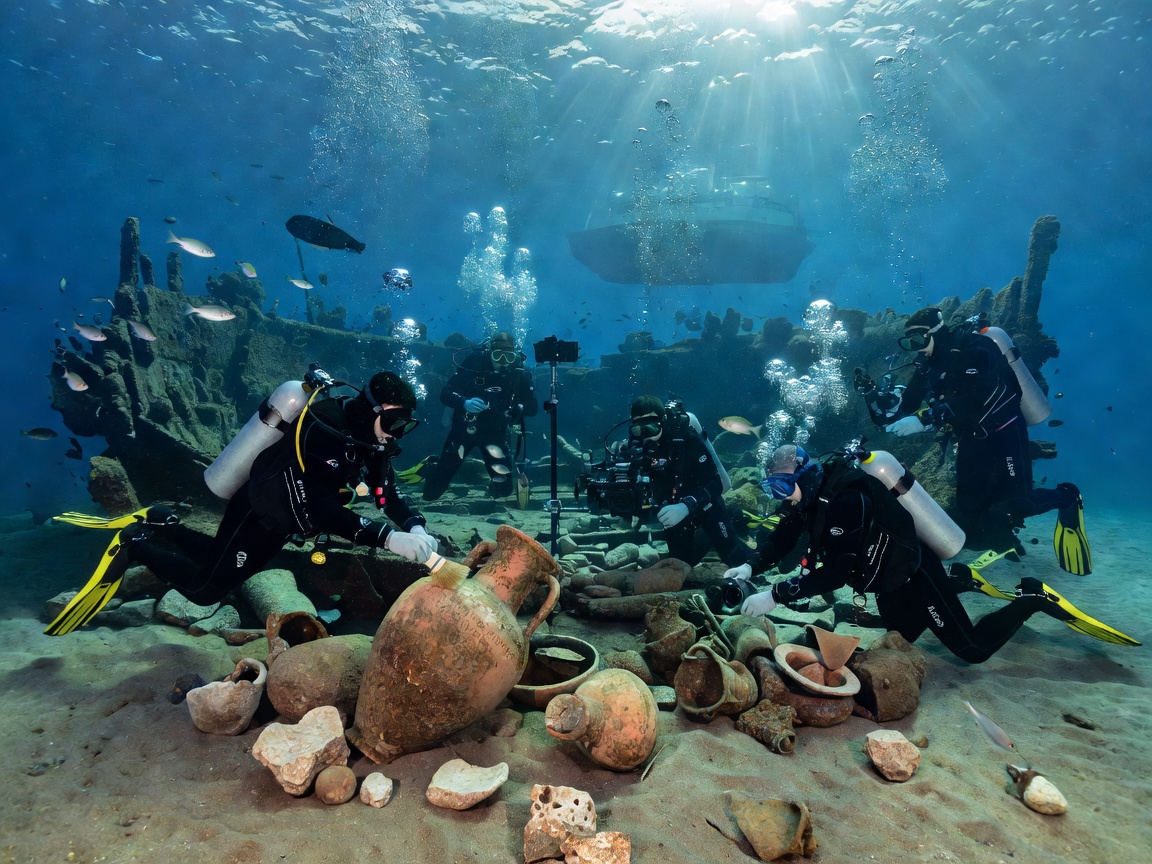
Discovered during a high-resolution side-scan sonar survey off Xlendi Bay, Gozo, the Phoenician shipwreck rests on a silt-covered seabed at 110 meters below sea level. Dated to approximately 700 BC, this vessel carried a diverse commercial cargo between Phoenician colonies in North Africa, Sicily, Sardinia, and the Maltese Archipelago.
Intact Cargo & Trade Artifacts
The seabed site covers an area of roughly 12 by 5 meters and remains remarkably well-preserved due to its depth. The visible cargo consists of seven distinct ceramic container types, including rare urns, wine amphorae manufactured in Western Phoenicia, and lava-stone querns (grinding stones used for grain processing) originating from Pantelleria or Sicily.
"The Xlendi shipwreck is a time capsule of Archaic Mediterranean commerce, revealing trade routes that connected Levant merchant networks with Central Mediterranean ports."
- Location: Xlendi Bay, Gozo, Malta
- Depth: 110 meters (360 feet)
- Estimated Date: c. 700 BC (Archaic Phoenician Period)
- Methodology: Photogrammetry, Remote Operated Vehicles (ROV), Technical Mixed-Gas Diving
Sub-Sea Photogrammetry & Virtual Museum
Because of the extreme depth, researchers from the University of Malta, CNRS, and Heritage Malta utilized autonomous underwater vehicles (AUVs) and high-definition photogrammetry to record thousands of overlapping digital images. This produced an millimetric 3D digital model of the site, permitting non-destructive virtual excavation and public access via underwater VR exhibits.